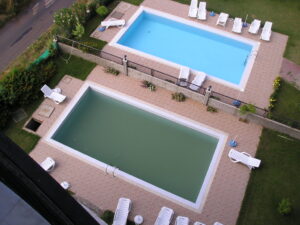
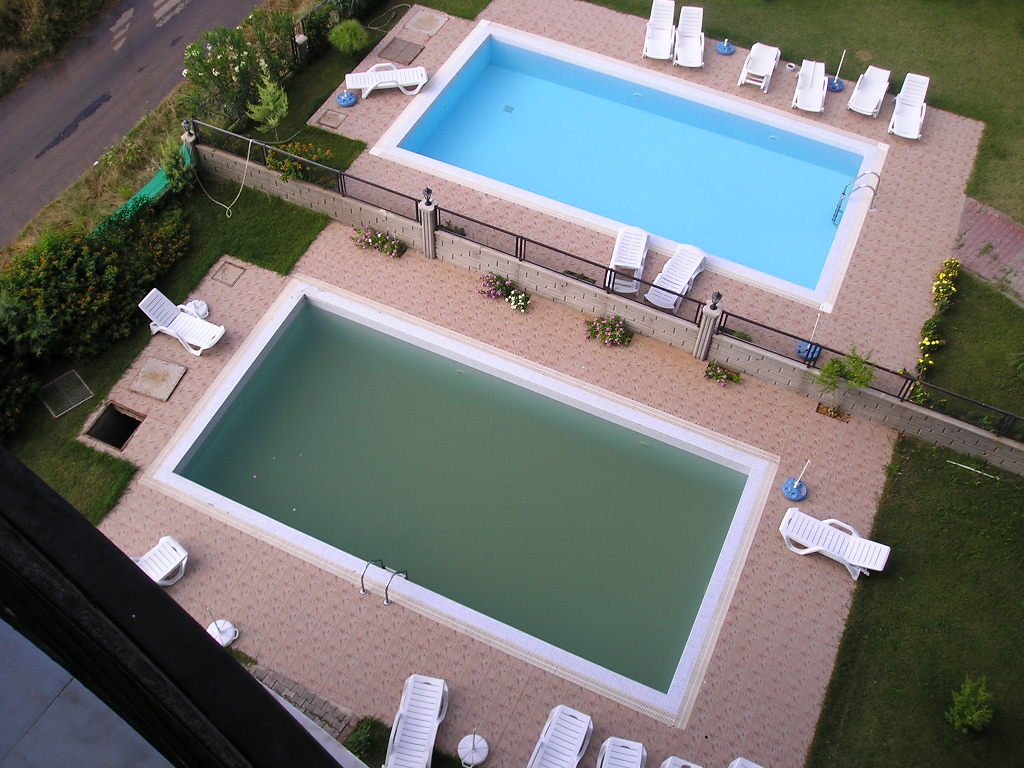
Heavy rain can turn a Miami pool green by diluting sanitizer levels, changing water chemistry, and introducing leaves, dirt, pollen, and other contaminants. South Florida’s warm conditions can make the problem develop quickly. However, if your pool turns green after nearly every ordinary storm, circulation, filtration, or equipment performance may also deserve a closer look.
One green pool after an unusually severe storm does not automatically indicate an equipment problem. Repeated algae after routine rainfall is different. In that situation, the rain may be exposing a pool that is already operating close to the limits of its normal chemistry, circulation, or filtration.
Why Does Heavy Rain Create Conditions for Algae?
Heavy rainfall changes several conditions inside a swimming pool at the same time. It adds untreated water, can reduce the concentration of sanitizer, affects the overall water balance, and carries additional organic debris into the pool.
After a typical South Florida storm, a pool may be dealing with:
- Lower effective sanitizer levels as rainwater increases the total volume of water.
- More organic debris for chlorine and filtration to handle.
- Changes in pH and overall water chemistry that can affect how effectively sanitizer works.
- Heavy debris in skimmers or filters that can interfere with normal water movement.
- Warm weather and strong sunlight, which can place additional demand on pool sanitation.
The Centers for Disease Control and Prevention (CDC) recommends routinely checking free chlorine and pH because both are fundamental to maintaining properly disinfected pool water.
The important point is that rain rarely acts alone. It changes the environment inside the pool, and algae can take advantage when sanitation, filtration, or circulation cannot keep up.
What Should You Do If Your Pool Turns Green After Rain?
Start by identifying what changed rather than automatically adding more chemicals. A green pool can result from inadequate sanitizer, algae growth, poor circulation, filtration problems, or a combination of factors.
A basic post-storm check should include:
- Removing significant leaves and storm debris.
- Testing chlorine and pH instead of estimating water conditions by appearance.
- Confirming that the pump and filtration system are operating normally.
- Treating the water according to the actual test results and the requirements of the pool system.
If the pool quickly returns to normal and the problem only occurs after unusually severe weather, there may be little reason to suspect a larger mechanical issue.
If the same problem happens after almost every storm, the pattern becomes more important than the individual algae bloom.
Why Does My Pool Turn Green After Every Storm?
A pool that repeatedly develops algae after ordinary rainfall may already be operating with limited sanitizer reserve, uneven circulation, inadequate filtration, or equipment that is not performing as intended.
That does not mean every recurring green pool needs a new pump or filter. Water chemistry should still be evaluated first. But once chemistry is consistently being managed, recurring algae can justify looking beyond chemicals.
For example, algae that repeatedly appears on the same steps, corners, benches, or other areas can sometimes indicate locations where water circulation is weaker.
Likewise, a pool that remains cloudy much longer than expected after a storm may warrant a closer evaluation of both filtration and water chemistry.
What Is Your Pool Telling You?
| What You Notice | Possible Contributing Factor | What to Investigate |
|---|---|---|
| Green water after nearly every storm | Chemistry, circulation, or filtration may already be marginal | Water balance, pump operation and filtration |
| Algae repeatedly appears in the same corners or steps | Areas of weaker circulation | Return direction and water movement |
| Return flow feels unusually weak | Restricted flow or equipment issue | Pump, filter, valves and plumbing |
| Water remains cloudy unusually long | Filtration or chemistry problem | Filter condition, flow and water balance |
| Equipment performance has noticeably declined | Aging or malfunctioning components | Professional equipment evaluation |
These symptoms are not a remote diagnosis. They are signs that help determine what should be checked next.
Can Better Circulation and Filtration Help Prevent Recurring Problems?
Yes, when circulation or filtration is actually part of the problem. A properly designed pool system moves water through the filtration equipment and returns treated water throughout the pool, helping the sanitizer and filter do their jobs effectively.
This is where equipment condition becomes relevant.
An aging pump, heavily restricted filter, poorly performing valves, or other hydraulic limitations can make recovery after storms more difficult. Conversely, replacing equipment that is already functioning correctly will not solve a chemistry problem.
Modern variable-speed pumps can also operate at different speeds for different pool functions. ENERGY STAR notes that variable-speed pumps can match pump speed to the task and operate more efficiently than running a conventional pump continuously at one high speed.
For homeowners whose recurring pool problems are connected to aging equipment, circulation, or filtration, these issues can be evaluated as part of pool remodeling and equipment upgrades in Miami.
The goal should be to identify the actual limitation rather than replacing equipment simply because the water turned green once.
Can Smart Pool Automation Help After Heavy Rain?
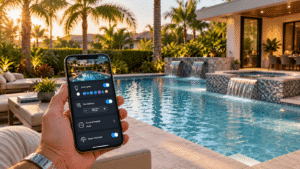
Smart automation can make it easier to maintain consistent equipment schedules and adjust compatible pool systems after changing weather conditions, but automation does not prevent algae by itself.
Depending on the equipment installed, modern pool controls can allow homeowners to adjust pump schedules, manage compatible variable-speed pumps, control heating and lighting, and monitor multiple pool functions from a centralized app.
After periods of unusually heavy use or weather, having easier control over equipment schedules can be useful. The important distinction is that automation manages the equipment — it does not replace appropriate sanitizer levels, water testing, or filtration.
Homeowners considering this type of upgrade can learn more in our guide to smart pool automation in Miami.
Is Green Pool Water Always Algae?
No. Green water is commonly associated with algae, but color alone does not prove that algae is the cause.
A CDC residential pool reference distinguishes between different appearances of green water. A dull or uneven green color can be associated with algae growth, while certain dissolved metals can also affect water color. Iron, for example, can contribute to brighter green coloration, while copper can produce a bluish-green appearance.
That distinction matters because adding more chlorine will not necessarily correct every cause of green water.
If the water changes color immediately after chemicals are added, remains clear despite the green tint, or does not respond as expected to normal algae treatment, water chemistry and dissolved metals may deserve investigation before assuming that the pool has an algae bloom.
Can You Swim in a Green Pool?
It is better to stay out of a green or cloudy pool until the cause has been identified, appropriate sanitizer levels are confirmed, and visibility has returned to normal.
Water clarity is also a safety issue. Swimmers should be clearly visible through the water, including at the deepest areas of the pool.
Testing is more reliable than deciding that water is safe based only on how green or clear it appears.
Should You Drain a Pool After Heavy Rain in Miami?
No. An inground pool should not be completely drained simply because heavy rain has turned the water green.
This is especially important in South Florida.
UF/IFAS Extension advises Florida homeowners not to drain or partially drain a swimming pool before a major rain event. When surrounding soil becomes saturated, water outside the pool creates pressure against the structure. Keeping water inside the pool helps counter that external pressure.
After a storm, excess water may eventually need to be returned to the pool’s proper operating level, but that is very different from emptying the pool.
For Miami homeowners, this is an important example of why pool advice that works elsewhere in the country does not always translate directly to South Florida conditions.
Frequently Asked Questions About Green Pools After Rain
Does rain lower chlorine in a swimming pool?
Heavy rain adds untreated water to the pool and can reduce the concentration of sanitizer. Storm debris and other contaminants can also increase the demand placed on chlorine. Because chlorine and pH should be routinely monitored, testing after substantial rainfall is more reliable than assuming the water remained balanced.
Should I shock my pool every time it rains?
Not automatically. Treatment should depend on the pool’s actual sanitizer level, chemistry, water clarity, and whether algae is present. Adding chemicals without testing can result in unnecessary or inappropriate treatment.
Can a variable-speed pump prevent algae?
Not by itself. A variable-speed pump can support consistent circulation and filtration when properly designed and programmed, but preventing algae still depends on sanitizer, water chemistry, filtration, circulation, and overall pool operation. Variable-speed technology does allow pump speed to be matched more efficiently to different pool functions.
Why does algae keep appearing in the same part of my pool?
Repeated growth in the same corners, steps, benches, or other areas may indicate weaker circulation in those locations, although chemistry and other factors should also be checked before assuming there is a hydraulic problem.
Can a saltwater pool turn green after heavy rain?
Yes. A saltwater pool still relies on chlorine for sanitation; the chlorine is simply generated by the salt chlorination system. Rain, contamination, water chemistry, circulation, and equipment operation can still create conditions in which algae develops.
Why is my pool still green after adding chlorine?
Several possibilities exist. Algae may not yet be fully controlled, filtration may need additional time, circulation may be inadequate, chemistry may be interfering with treatment, or the green color may have another cause such as dissolved metals.
When Green Water Becomes a Pattern, Look Beyond the Storm
A Miami rainstorm can temporarily disrupt even a properly operating swimming pool. One algae problem after extreme weather does not automatically mean that the pump, filter, or plumbing needs to be replaced.
The more important signal is recurrence.
If the pool turns green after nearly every normal rainstorm, takes unusually long to clear, repeatedly develops algae in the same areas, or shows declining circulation and filtration performance, the storm may be revealing a weakness that already existed.
At that point, the right question is no longer simply “How much chlorine should I add?”
It becomes:
“Is my pool system circulating and filtering water as effectively as it should?”
Elite Pool Construction helps Miami homeowners evaluate and modernize aging pool equipment as part of larger pool remodeling and equipment upgrade projects or new pool construction, including pumps, filtration, automation, lighting, and other functional improvements.
The objective is not to replace equipment unnecessarily. It is to build a pool system that works reliably for the way South Florida homeowners actually use their pools — including after the weather changes.