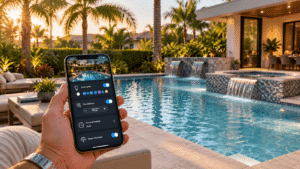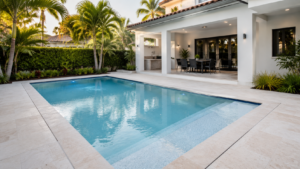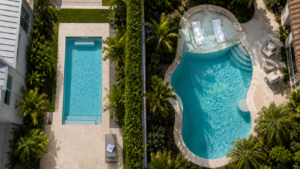
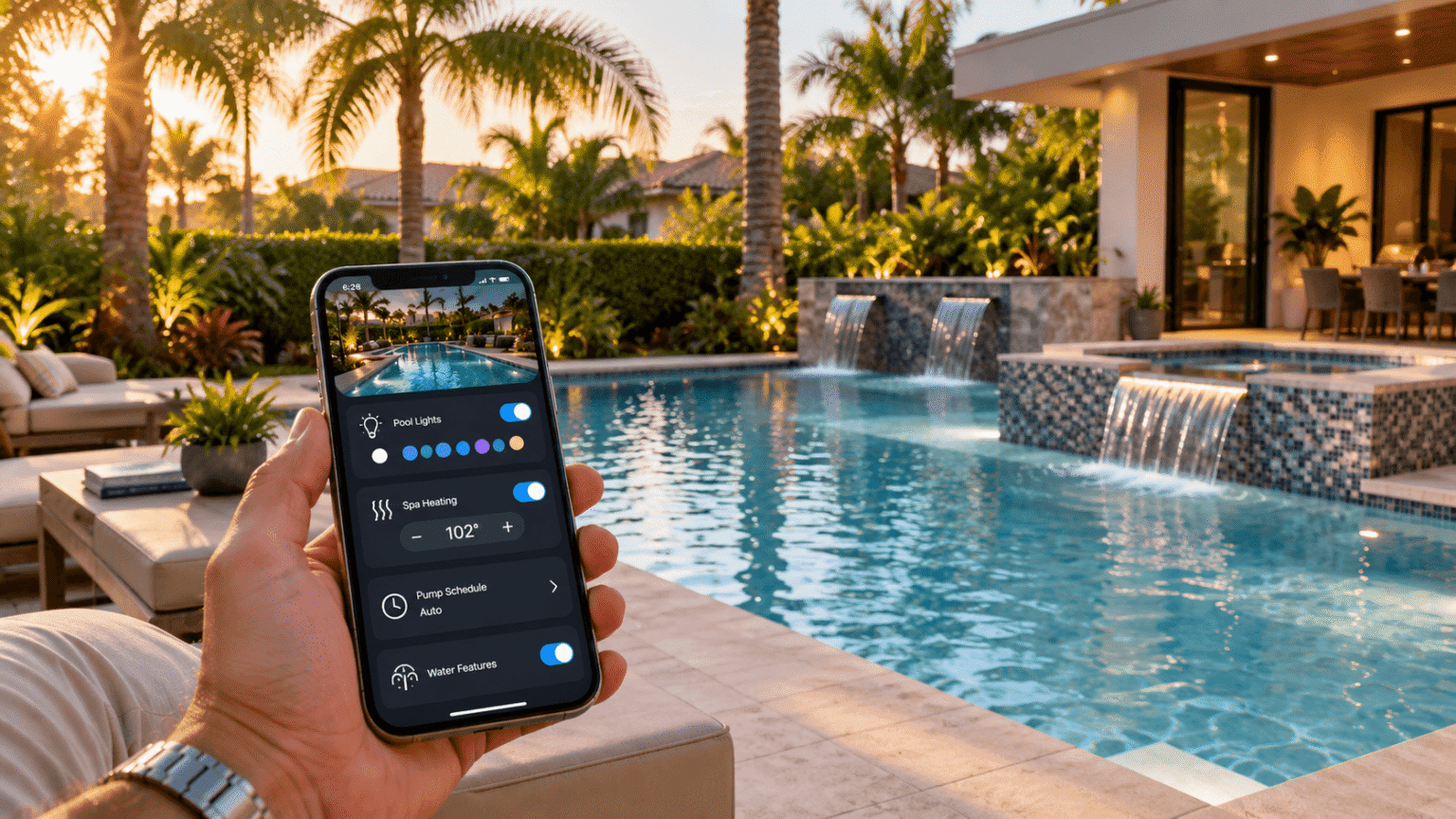
Smart pool automation can be worth it for Miami homeowners who want centralized control over pumps, heating, lighting, filtration schedules, spas, and compatible water features. It is especially useful for pools with multiple systems, where remote access and automated schedules can simplify daily operation and reduce unnecessary equipment runtime.
For South Florida homeowners, the value goes beyond turning pool lights on from a phone. A well-designed system can coordinate several pieces of equipment and make a more complex pool-and-spa setup easier to manage.
What Is Smart Pool Automation?
Smart pool automation connects compatible pool equipment to a centralized digital controller, allowing homeowners to schedule, monitor, and adjust functions through a control panel or smartphone app.
Depending on the system, that can include pumps, heaters, LED lighting, water features, automated valves, and compatible sanitization equipment.
The key word is compatible. Pool automation is not a universal remote for every piece of equipment. Existing hardware, electrical configuration, communication protocols, and equipment brands all affect what can be integrated.
What Can You Actually Control From Your Phone?
A modern smart pool system can control many of the functions homeowners adjust most often:
- Pumps and filtration: Schedule variable-speed pumps for filtration, cleaning cycles, spa operation, or water features.
- Pool and spa heating: Monitor or activate compatible heat pumps and gas heaters remotely.
- LED lighting: Schedule supported lights and, depending on the system, adjust colors, programs, brightness, or zones.
- Water features and valves: Control compatible waterfalls, deck jets, bubblers, spillovers, fountains, or spa functions through motorized valve actuators.
- Sanitization: Some platforms integrate with compatible salt chlorine generators or chemistry equipment, allowing certain settings or system information to appear in the same interface.
Automation does not replace proper water testing or regular pool care. The amount of control depends on the equipment installed.
Is Smart Pool Automation Worth It for Miami Homeowners?
Pool automation provides the greatest practical value when homeowners regularly manage several pool systems. A simple pool with limited equipment may benefit less than a pool with a spa, variable-speed pump, heating, lighting, and multiple water features.
| Pool Setup | Potential Value | Main Benefit |
|---|---|---|
| Basic pool with limited equipment | Lower / Optional | Scheduling convenience |
| Pool + variable-speed pump | Good | Scheduling and speed control |
| Pool + heater and spa | High | Remote heating and temperature management |
| Pool + spa + LED lighting + water features | Very High | Unified control of multiple systems |
Automation should solve an actual operational problem. For a straightforward backyard pool, an advanced platform may provide more functionality than necessary. For a larger setup in Pinecrest or Coral Gables with a spa, heating, lighting, and water features, centralizing several systems can make daily operation much easier.
The better question is not simply, “Can this pool be automated?” It is, “Which parts are actually worth automating?”
Can Smart Pool Automation Reduce Energy Use?
Pool automation can help reduce unnecessary equipment runtime and improve scheduling, but the controller itself is not what makes pool equipment energy-efficient. Actual energy use depends largely on the pump, heater, operating speeds, schedules, and how the pool is used.
Variable-speed pumps can use substantially less energy when lower speeds are appropriate for tasks such as filtration. Automation complements that technology by helping schedule appropriate speeds and operating periods.
In short, efficient equipment creates the opportunity for energy savings; automation helps manage it more intelligently.
Florida Power & Light also offers an optional Residential Time-of-Use rate with separate on-peak and off-peak periods. Miami homeowners enrolled in that program may be able to schedule compatible pump cycles or electric heating equipment around off-peak periods when practical. This should not be confused with FPL’s standard residential rate.
Can You Add Automation to an Existing Pool?
Yes. Many existing pools can be upgraded with smart controls without rebuilding the pool itself. The complexity depends on the current equipment, electrical configuration, equipment brands, and functions being automated.
A retrofit may involve upgrading a control panel, adding networking equipment or valve actuators, or replacing components that are not compatible with the selected platform.
That makes automation especially relevant during pool remodeling and equipment upgrades in Miami. When older pumps, lighting, heaters, or controls are already being evaluated, homeowners can determine which components should remain and what level of automation makes sense.
The age of the pool shell is usually less important than the compatibility and condition of the equipment connected to it.
What Should You Look for in a Smart Pool Automation System?
The right automation system should work with the pool’s existing equipment, support the features the homeowner uses, and allow for likely future upgrades.
Consider:
- Compatibility with pumps, heaters, lighting, and sanitization equipment
- Number of pumps, valves, lights, and water features to control
- Future expansion
- Network and remote-access requirements
- Ease of using the mobile app
- Support and replacement components
- Whether existing equipment already belongs to one manufacturer’s ecosystem
Pentair IntelliCenter and Hayward OmniLogic are useful examples. IntelliCenter integrates with the Pentair Pool App for compatible equipment, while Hayward’s OmniLogic ecosystem provides mobile control of supported pumps, heaters, lighting, water features, and other equipment.
There is no universal “best” controller. The best choice depends on the equipment already installed and what the homeowner actually wants the system to do.
Is It Better to Add Automation During a Remodel or New Pool Construction?
Automation can be installed in an existing pool, but a remodel or new construction project makes it easier to plan equipment, electrical infrastructure, valves, lighting, and future features as one coordinated system.
For new pool construction, automation can be considered during the design stage so wiring, conduit, equipment placement, heating, lighting, and water features are planned around the intended control system.
For an existing pool, swimming pool remodeling in Miami is a natural time to evaluate older pumps, lighting, heaters, and controls before deciding what should be automated.
The goal is not to install the most advanced technology available. It is to create a pool that is easier to operate and better suited to how the homeowner uses the backyard.
Frequently Asked Questions About Smart Pool Automation in Miami
Can I control my pool automation system while away from home?
Yes. Many modern systems provide remote access through an internet-connected smartphone app. Available functions depend on the controller and compatible equipment.
Does smart pool automation work with saltwater pools?
Yes. Certain systems integrate with compatible salt chlorine generators. Functions may include chlorine-output control, system status, salinity information, or diagnostic alerts.
Does pool automation lower electricity costs?
Automation can reduce unnecessary runtime and improve scheduling, but it does not guarantee a specific reduction in electricity costs. Efficient equipment, especially properly operated variable-speed pumps, has a more direct impact on energy consumption.
Can an older pool in Miami be upgraded with smart controls?
Often, yes. Existing pools can frequently receive modern automation controls, although older pumps, heaters, electrical components, or controllers may need to be upgraded for compatibility.
Does smart pool automation require Wi-Fi near the equipment pad?
Not necessarily. Remote app control requires network connectivity, but depending on the system, that may use Wi-Fi, a wireless bridge, or wired Ethernet.
Make Pool Technology Work for the Way You Use Your Backyard
Smart pool automation makes the most sense when it solves a real operational need. For Miami homeowners managing a spa, variable-speed pump, heating, LED lighting, or multiple water features, bringing those functions into one system can make the pool much easier to operate.
For a simpler pool, an advanced platform may provide limited practical benefit. The technology should fit the pool—not the other way around.
If you are modernizing an existing pool, Elite Pool Construction can evaluate automation alongside pumps, lighting, heating, and other equipment upgrades as part of a broader pool remodeling project. For a new pool, planning these systems together can create a cleaner, more integrated setup built around how you actually use your backyard.